Use an AI cover letter generator to write a sharper, tailored letter in 30 seconds—without sounding robotic or generic.
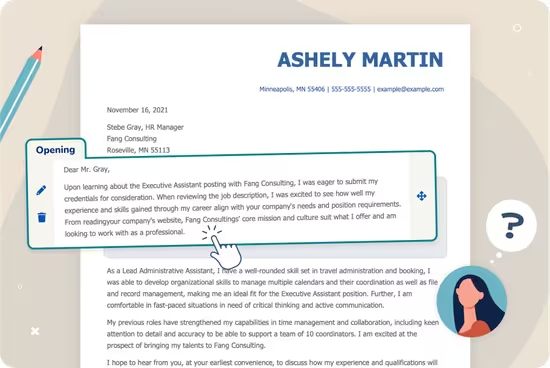
An AI cover letter generator can turn a blank page into a tailored draft in 30 seconds. That matters, because most job seekers still waste hours writing letters recruiters barely skim. Speed helps. But only if the result sounds like you, not a chatbot wearing a blazer.
What is an AI cover letter generator?
An AI cover letter generator is a tool that creates a first draft of your cover letter from your resume, a job description, and a few personal details. Its real job is not to think for you. It is to give you a strong base fast, so you can edit for accuracy, personality, and relevance.
Simple definition. Big difference.
A lot of people treat AI like a vending machine. Insert job title. Press button. Get hired.
That is not how this works.
The best use of AI is closer to having a sharp assistant sitting next to you. It pulls the raw material together. You still decide what stays, what goes, and what actually sounds human.
According to LinkedIn's 2025 Future of Recruiting insights, recruiters spend only a few minutes on average evaluating an application package in the first pass. Per a 2026 McKinsey report on generative AI at work, knowledge workers save significant time on first-draft writing tasks when AI is used for structured content. And a 2025 Jobscan hiring behavior study found that tailored applications consistently outperform generic ones in callback rates.
The lesson is obvious.
A fast draft is useful. A generic draft is useless.
Why AI-written cover letters work when used properly
Cover letters are awkward for a reason.
You are trying to sound confident without sounding arrogant. Specific without rambling. Human without oversharing. Most people either write too stiff or too vague.
AI helps with three hard parts.
1. It kills the blank-page problem
The hardest sentence is usually the first one. AI solves that in seconds.
Instead of staring at a blinking cursor like it owes you money, you get a structure:
- opening tailored to the role
- body paragraphs tied to achievements
- closing with a clear call to action
That alone saves time and mental energy.
2. It spots patterns in job descriptions fast
A good generator can identify repeated themes in the posting:
- required skills
- keywords tied to ATS screening
- business priorities
- tone of the company
If a company mentions stakeholder management four times, that is not decoration. They are telling you what they care about.
Your cover letter should mirror the employer's priorities, not your entire life story.
3. It makes customization less painful
This is where it gets interesting.
Most job seekers know they should tailor every cover letter. They just do not, because it is slow. According to a 2025 Greenhouse candidate experience benchmark, application abandonment rises sharply when the process feels repetitive and time-consuming.
So people reuse the same letter 20 times.
Recruiters can smell that from across the building.
AI makes customization realistic. Not perfect. Realistic.
Can recruiters tell if you used an AI cover letter generator?
Yes. Often.
Recruiters can usually tell when a cover letter was generated by AI if you leave the obvious fingerprints in place: vague praise, inflated language, generic claims, and zero concrete evidence.
Here is what gives you away fast:
- "I am excited to apply for this amazing opportunity"
- "I have a proven track record of success"
- "I am confident my skills align perfectly"
- long sentences that say nothing
- achievements with no numbers, scope, or context
That style is the written version of a weak handshake.
According to a 2026 survey by Resume Genius, a majority of hiring professionals said they were not against AI-assisted applications, but they reacted negatively to content that felt generic or dishonest. The issue is rarely the tool itself. The issue is laziness.
Recruiters do not care whether you used AI the way chefs do not care whether you used a sharp knife. They care about the result.
The line you should not cross
Using AI to draft and refine your letter? Fine.
Using AI to invent experience you do not have? Stupid.
That is where people get burned. If your letter claims you led a 12-person team and your interview answers fall apart in 45 seconds, the process is over.
AI should sharpen your truth, not manufacture a new identity.
How to write a perfect cover letter in 30 seconds
You can get a strong first draft in half a minute if you feed the tool the right inputs. Garbage in, garbage out. Same rule as ever.
Here is the fastest workflow that actually works.
Step-by-step: the 30-second method
1. Paste the full job description
Not just the title. The actual posting. Skills, responsibilities, qualifications. The details matter.
1. Add your current resume
Use the version closest to the role. If your resume is messy, fix that first.
1. Give 3 specific achievements
Example: "Increased email conversion by 18% in 4 months," "Reduced ticket backlog by 32%," "Managed a
1. Set the tone
Choose 2-3 words: direct, warm, analytical, persuasive, concise.
1. Tell it why this company
One sentence is enough. Product, mission, market, growth stage, team. Something real.
1. Generate the draft
Now you have something usable. Not finished. Usable.
1. Edit for proof of work
Replace fluff with specifics. Remove clichés. Shorten the opening. Check every claim.
That is the whole system.
Fast. Practical. Repeatable.
The prompt that gets better results
If your tool allows a custom prompt, use one like this:
> Write a one-page cover letter for the job below using my resume details and these three achievements. Keep the tone confident, specific, and human. Avoid clichés, corporate buzzwords, and exaggerated claims. Mirror the job description's priorities and include measurable results where possible.
That one instruction removes half the junk AI usually produces.
> 💡 Cubbbe Tip: Before generating your letter, run your resume through Resume Lab - CV Analysis. A sharper resume gives the AI better material, which means a better cover letter draft.
What should you edit before sending an AI cover letter?
This part is not optional.
If you send the first draft untouched, you are gambling with your application. And the house usually wins.
Fix the opening paragraph first
Most AI openings are too polite, too broad, and too forgettable.
Bad:
> I am writing to express my strong interest in the Marketing Manager position at your esteemed company.
Nobody talks like that unless they were raised by a fax machine.
Better:
> Your team is hiring a Marketing Manager to grow pipeline through multi-channel campaigns. That caught my attention because I have spent the last three years doing exactly that, including a demand-gen program that lifted qualified leads by 22%.
See the difference?
One sounds like every applicant. The other sounds employed.
Replace generic claims with evidence
AI loves empty praise. Cut it.
Swap this:
- strong communication skills
- team player
- results-driven professional
- passionate about innovation
For this:
- led weekly client reviews across sales, product, and support
- trained 6 new hires during a system migration
- grew retention from 81% to 89% in two quarters
- launched a reporting workflow that cut manual work by 5 hours a week
Evidence beats adjectives. Every time.
Check for fake personalization
This is a common AI trap.
The letter says it is tailored, but the details are thin. It praises the company without saying anything that could not apply to 500 other employers.
Weak personalization:
- "I admire your commitment to excellence"
- "Your company stands out in the industry"
- "I am inspired by your innovative culture"
Real personalization:
- mention a recent product launch
- refer to the company's expansion into a market
- connect with a stated value from the job post
- point to a challenge the role is clearly trying to solve
You do not need a love letter. You need proof you paid attention.
AI cover letter generator vs writing from scratch
Some people still insist every cover letter should be handcrafted from the ground up.
Nice idea. Unrealistic for most job searches.
If you are applying to 15, 30, or 80 roles, writing every letter from zero is like insisting on grinding your own flour before making toast.
Here is the practical comparison:
| Method | Speed | Customization | Risk | Best use case |
|---|---:|---:|---:|---|
| Writing from scratch | Slow | High if done well | Time drain | Senior roles, highly targeted applications |
| AI first draft + human edit | Fast | High | Low if edited | Most job seekers, most applications |
| Copy-paste generic template | Very fast | Low | Very high | Almost never worth it |
The middle option wins for most people.
Not because it is trendy. Because it matches reality.
According to a 2025 Harvard Business Review analysis of AI at work, hybrid workflows outperform both fully manual and fully automated approaches in many communication tasks. That tracks with what recruiters see every day: the best applications are efficient but still personal.
When writing from scratch still makes sense
There are exceptions.
Write manually when:
- you are applying for a role in communications, policy, or writing-heavy fields
- the company explicitly asks for a highly personal letter
- you are making a career pivot and need tighter narrative control
- the role is senior enough that every line carries more weight
For everyone else, AI is the better starting point.
How do you make an AI cover letter sound human?
Use fewer claims. Add more texture.
That is the whole game.
A human cover letter has fingerprints. Specific moments. Real trade-offs. Slightly uneven rhythm. It does not read like it was assembled in a conference room by a committee of motivational posters.
5 ways to humanize the draft
1. Use one concrete story
Not your autobiography. One moment.
Example:
> In my last role, our onboarding emails had a 14% click-through rate and nobody knew why. I rebuilt the sequence around customer objections, tested three subject-line frameworks, and pushed CTR to 23% in six weeks.
That sounds lived-in. Because it is.
2. Keep one line slightly conversational
A little personality helps.
Example:
> I like messy problems, especially the kind that sit between teams and never seem to belong to anyone.
That line tells me more than "I am a proactive problem-solver" ever will.
3. Cut half the intensifiers
Delete words like:
- very
- highly
- truly
- deeply
- incredibly
- extremely
They add volume, not value.
4. Shorten long sentences
AI tends to stack clauses like a bad sandwich.
If a sentence runs over 25 words, test a shorter version. Your letter should feel crisp, not ceremonial.
5. Read it out loud
This is the best filter I know.
If you would never say the sentence in an interview, rewrite it. Your cover letter and your spoken answers should sound like they came from the same person.
A mini case study: same candidate, two very different letters
Let me show you how this plays out.
Say you are Mia. Three years in customer success. Applying for an Account Manager role at a SaaS company.
Version 1: generic AI draft
- says Mia is "excited"
- mentions "strong interpersonal skills"
- claims she is a "results-oriented professional"
- repeats phrases from the job post
- includes no metrics
This version is wallpaper. It exists, but nobody remembers it.
Version 2: edited AI draft
- opens with the company's need to grow renewals and expansion revenue
- mentions Mia managed 42 mid-market accounts
- states she lifted renewal rate from 84% to 91%
- explains she partnered with product to resolve a churn issue affecting onboarding
- closes by linking her experience to the company's growth stage
Now we have traction.
Same candidate. Same background. Better framing.
The difference was not talent. It was specificity.
If you want this process to move faster across multiple roles, it helps to keep your core materials clean and reusable. A structured resume in Document Manager makes it easier to pull accurate achievements into each draft. And if you are applying at scale, Application Tracking helps you keep versions straight so you do not send the wrong letter to the wrong company. That mistake happens more than people admit.
The biggest mistakes people make with AI cover letters
These are the errors that quietly kill applications.
Sending the first draft untouched
This is the classic one.
You save 10 minutes and lose the interview. Bad trade.
Using fake metrics
If you cannot explain the number in an interview, do not use it.
Overstuffing keywords
Yes, ATS matters. No, your letter should not read like a keyword dump.
Bad writing does not become good because it includes "cross-functional collaboration" three times.
Making it too long
A cover letter is not a witness statement.
Aim for 250 to 400 words for most roles. Enough to show fit. Not enough to test anyone's patience.
Repeating the resume line by line
Your resume gives the outline. Your cover letter gives the angle.
Different jobs.
Forgetting the company problem
The employer is not hiring you to admire yourself in paragraph form. They have a gap. A target. A mess. A backlog. A growth problem.
Your letter should make it easier to picture you helping.
What recruiters actually want from your cover letter
Not poetry. Not your life story. Not a TED Talk.
They want four things:
1. Why this role
Not any role. This one.
1. Why you fit
Based on evidence, not vibes.
1. Why this company
A real reason. Even a short one.
1. Why now
Why this move makes sense in your trajectory.
If your letter answers those four points cleanly, you are ahead of most applicants.
According to a 2025 LinkedIn hiring trends update, relevance is one of the strongest predictors of recruiter engagement. That means your application should feel aligned, not merely impressive.
There is a big difference.
A candidate can be impressive and still feel wrong for the role.
A simple structure that works
Use this framework:
- Paragraph 1: why this role and your strongest fit
- Paragraph 2: one or two relevant wins with numbers
- Paragraph 3: why this company and a clear close
That is it.
No drama. No filler. No recycled motivational fluff.
FAQ
Is it okay to use an AI cover letter generator for job applications?
Yes, using an AI cover letter generator is fine if you edit the draft before sending it. Recruiters care far more about relevance, honesty, and clarity than about whether AI helped you write the first version.
Do ATS systems read cover letters?
Some ATS systems do parse cover letters, but their importance varies by employer. The safer move is to include relevant keywords naturally while focusing on a clear, human-readable letter that supports your resume.
How long should an AI-generated cover letter be?
An AI-generated cover letter should usually be 250 to 400 words. That length is enough to show fit and personality without overwhelming a recruiter who may only skim the application package.
Can ChatGPT write a good cover letter?
Yes, ChatGPT can write a strong first draft when you provide a job description, resume details, and measurable achievements. The quality depends on your inputs and your editing, not on the tool alone.
Should every job application have a different cover letter?
Yes, every serious job application should have a tailored cover letter, even if only 20 to 30 percent changes. Small customization often makes the difference between sounding relevant and sounding mass-produced.
Final thoughts
An AI cover letter generator can save you hours, reduce friction, and help you tailor more applications. But the winning formula is not AI alone. It is AI speed plus human judgment.
Use the machine for the first draft. Use your brain for the final one. Because when the recruiter reads your letter, the real question is simple: does this sound like someone worth interviewing?